
Mortgage comparison Switzerland: banks, insurers and pension funds
Why a systematic comparison pays off: banks, insurers and pension funds side by side – conditions, strengths, limits. Neutral and with sources.
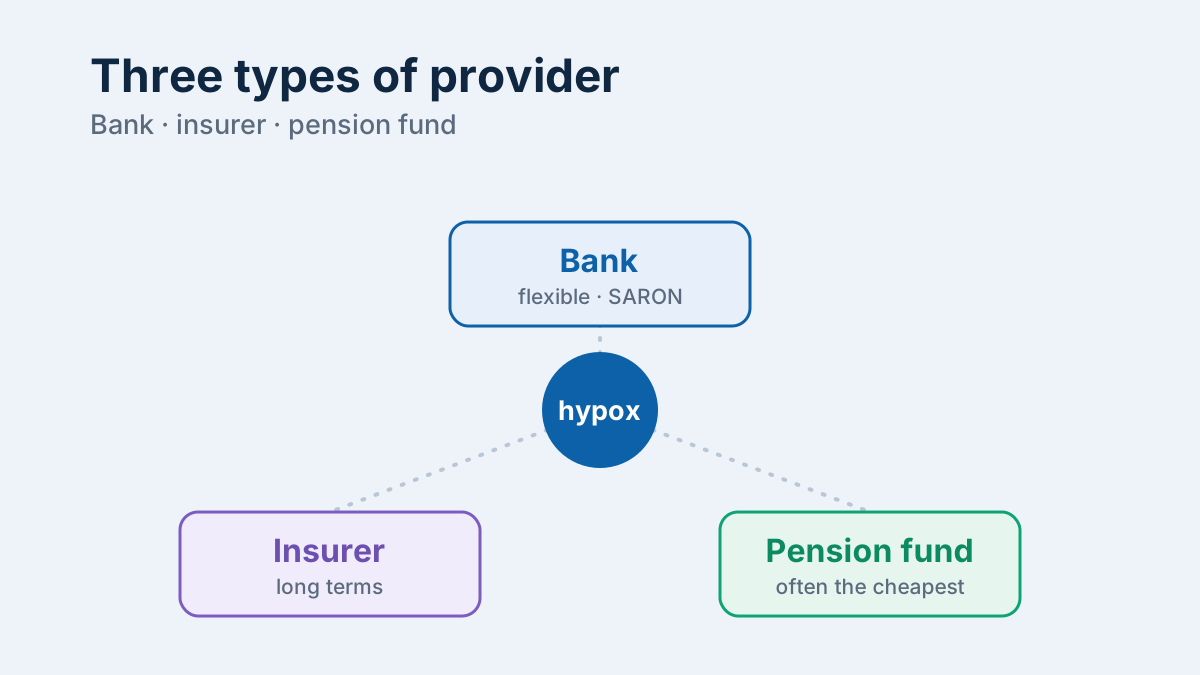
Anyone who only asks their own house bank for a mortgage is not comparing – and often leaves money on the table. The Swiss mortgage market is a competition between three types of provider with very different business models: banks, insurers and pension funds. Whoever understands their logic finds the most fitting financing.
This article compares the three provider types factually (as of January 2026).
Key points at a glance
- Three provider types, three logics: for banks the mortgage is core business; for insurers and pension funds it is an investment instrument.
- Pension funds often offer the cheapest rates for fixed-rate mortgages – on average around 20 basis points below banks – but are restrictive.
- Insurers are strong on very long terms (15–25 years).
- Banks are the most flexible for complex properties (e.g. holiday homes) and dominate SARON mortgages.
- The spread between the most expensive and the cheapest provider is considerable – which is why the systematic comparison pays off.
Banks: flexible, but more expensive due to regulation
Banks finance themselves via short-term customer deposits and transform them into long-term mortgages. They are universal financiers and the most flexible providers – for the self-employed, complex ownership situations and special properties such as holiday or investment properties. They also dominate the offering of flexible SARON mortgages.
The price for this: banks are subject to strict capital requirements (Basel III). For riskier mortgages they must hold more equity – costs they pass on via the rate. For second homes, some banks even levy flat rate surcharges. Our provider profiles show what individual institutions charge – for example Migros Bank or Raiffeisen.
Pension funds: often the cheapest rates – for standard properties
Pension funds manage retirement capital and seek stable, long-term returns. Because they run no branch network and are not subject to banking regulation, they work cost-efficiently – and often offer the lowest rates for fixed-rate mortgages. According to MoneyPark, bank customers pay on average around 20 basis points more for ten-year fixed-rate mortgages than at a pension fund; in a Blick example, a pension-fund mortgage saves around CHF 13,000 over ten years (at CHF 650,000 of volume).
The catch: high selectivity. Pension funds finance above all standardised primary residences in good locations for borrowers with first-class credit standing and low loan-to-value. Many exclude holiday flats and investment properties. Their market share is small – partly because they hardly do any sales. So you have to seek them out actively – examples with published guide rates are the PVK of the City of Berne or the SBB pension fund.
Insurers: strong on very long terms
Insurers invest premium income so that it matches their future obligations (asset-liability matching). They are therefore predestined for very long fixed-rate mortgages – 15, 20 or 25 years – and often cheaper than banks too. One example with continuously collected guide rates is Mobiliar.
Note: some insurers tie the mortgage to their own pension or life-insurance products (cross-selling for indirect amortisation). This can make sense – or dilute comparability.
The three types at a glance
| Criterion | Bank | Insurer | Pension fund |
|---|---|---|---|
| Fixed-rate mortgage rate | medium | often cheap | often cheapest |
| Property flexibility | high | low | low |
| SARON mortgage | yes | rarely | rarely |
| Very long terms | limited | strength | partly |
| Holiday / investment properties | possible | restrictive | mostly excluded |
No type is “the best” across the board. The cheapest offer depends on the property, loan-to-value, affordability and term – and varies considerably from provider to provider.
Why the systematic comparison is decisive
Because conditions vary so strongly, the advertised “from” rate says little. What matters is the offer for your profile. A technology-supported comparison platform obtains offers from many institutions in parallel, presents them transparently and filters out those that will not finance your property at all. That replaces the frustrating branch tour with an efficient market overview – and that is exactly the hypox approach. Why we stay neutral is explained under how we earn money.
The comparison is especially worthwhile for holiday properties, where the lending criteria diverge most strongly.
Frequently asked questions
Is the pension fund always the cheapest?
Often for fixed-rate mortgages and low loan-to-value – but not always, and many funds finance only standard primary residences. Comparing remains necessary.
Does only the interest rate count?
No. Term, flexibility (dissolution, partial repayment), ancillary costs and the provider’s property valuation are part of it too.
Where can I see current conditions?
On hypox you will find a continuously updated provider overview with indicative rates – your personal rate results from the concrete offer.
Conclusion
Banks, insurers and pension funds serve the same market with different strengths. Whoever opens only one door does not know the market. The systematic, neutral comparison is the most reliable way to fitting conditions – across all three provider types.
Sources
- MoneyPark – Mortgage from a bank, insurer or pension fund?
- hausinfo.ch – Mortgage: insurer or bank? (lenders compared)
- neho.ch – Mortgage from an insurer or bank?
- smzh – Mortgage providers: banks, insurers & pension funds compared
Note: time-dependent figures reflect the status as of January 2026 and serve for orientation, not advice. Only the conditions of the respective providers are binding.
Ready for the next step?
Compare the conditions of different providers neutrally and without commission interest.
Request an offer