
Fixed or SARON mortgage: how to find the right model
Fixed-rate mortgage or SARON? A factual, well-founded comparison covering the 2026 rate environment, prepayment penalty, tranche strategy and sources – neutral and without sales pressure.
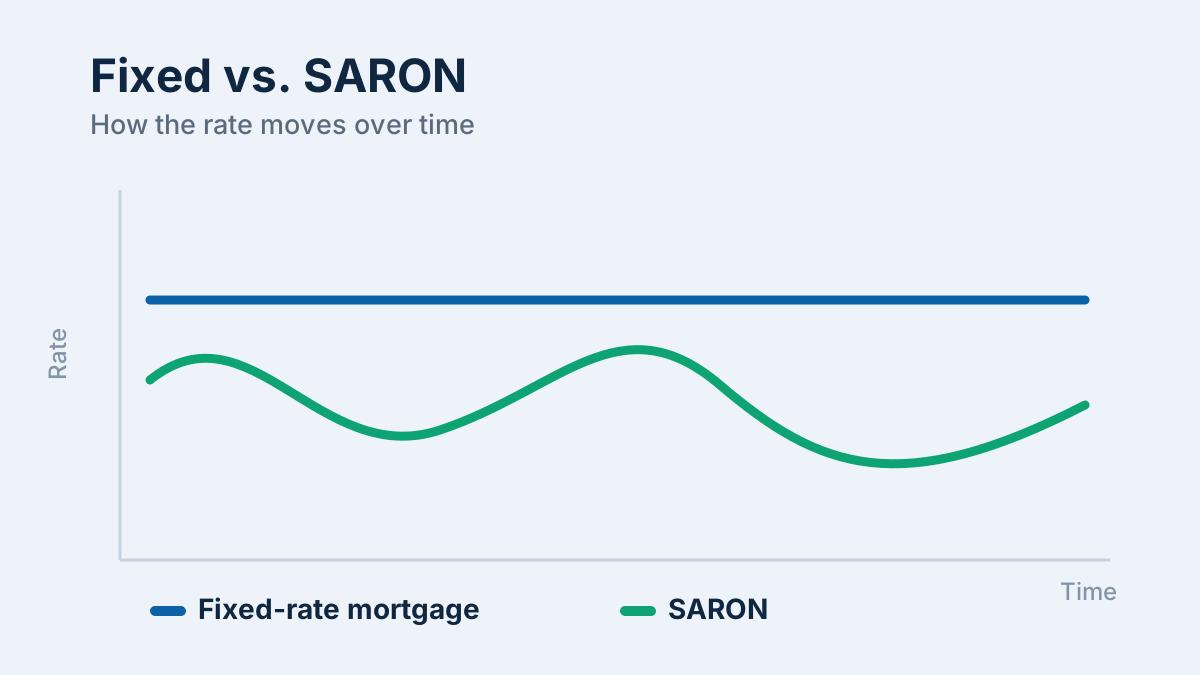
Anyone taking out or renewing a mortgage sooner or later faces the same question: fixed-rate mortgage or SARON mortgage? Both models have their place – the “right” one does not depend on the current rate trend, but on your personal situation, your risk appetite and your time horizon.
This article places both models in context: from the mechanics through the hidden costs to the 2026 market environment. It is no substitute for advice, but it helps you ask the right questions before you compare offers. All time-dependent figures are dated and sourced (as of July 2026).
Key points at a glance
- Fixed-rate mortgage = security comes at a price. You buy planning certainty and pay an interest-rate risk premium to the bank for it.
- SARON = flexibility and market proximity. You bear the interest-rate risk yourself, but have historically benefited from lower costs.
- Historically, the money-market mortgage was cheaper – across almost all rolling ten-year periods since 1993 (source: VZ VermögensZentrum).
- A prepayment penalty can make a fixed-rate mortgage expensive on an early exit – factor it in.
- What matters is not the advertised rate, but your loan-to-value, affordability and negotiation. That is why a neutral provider comparison pays off.
The fixed-rate mortgage: predictability over the whole term
With a fixed-rate mortgage you agree a fixed interest rate for a fixed term – usually two to ten, sometimes up to fifteen years. The rate stays unchanged over the entire period, regardless of how the market moves. Pricing is based on longer-term capital-market rates (swap rates), at which the bank refinances.
Above all, this brings one thing: planning certainty. You know from the first to the last day how high your interest costs are, and can budget accordingly. For households with tight affordability, that is a strong argument.
The flip side: you are tied in. If rates fall during the term, you do not benefit. And an early termination – for example when selling the property – can trigger a prepayment penalty (more on this below).
A fixed-rate mortgage is not a “bet on low rates”, but the purchase of security. The price for it is a risk premium and less flexibility.
The SARON mortgage: close to the money market
The SARON mortgage is based on the Swiss Average Rate Overnight (SARON) – a secured overnight rate derived from actual transactions in the Swiss interbank market and administered by SIX Group. It replaced the error-prone LIBOR at the end of 2021.
Because a mortgage is settled over an interest period of usually one to three months, the “compounded SARON” is used: the average of the daily compounded SARON rates over the elapsed period. This retrospective averaging smooths individual rate spikes – an extreme daily swing barely affects your quarterly charge over 90 days.
Your effective cost is additive: compounded SARON + individually negotiated bank margin. When the SARON is near or below zero, almost all banks apply a floor of 0.0 percent on the base value – you then effectively pay only the margin.
The key characteristics at a glance:
- Transparency: the base rate is publicly visible; you only negotiate the margin with the provider.
- Flexibility: SARON mortgages can usually be terminated at short notice (typically three to six months) or converted internally into a fixed-rate mortgage – without a prepayment penalty.
- Uncertainty: the future interest burden is not fixed – your budget must absorb fluctuations.
What is cheaper? A look at history
From a purely financial standpoint, the question can be answered empirically. According to the longitudinal analyses of VZ VermögensZentrum, money-market mortgages were cheaper across almost all rolling ten-year periods since 1993 than long-term fixed-rate mortgages.
Illustrative, rounded cumulative interest costs for a mortgage of CHF 500,000 (source: VZ VermögensZentrum; three-month LIBOR until 2021, SARON thereafter):
| Ten-year period | Money market (LIBOR/SARON) | Fixed-rate mortgage, 10 years |
|---|---|---|
| 1993–2002 | CHF 176,000 | CHF 355,000 |
| 1998–2007 | CHF 118,000 | CHF 288,000 |
| 2003–2012 | CHF 85,000 | CHF 207,000 |
| 2008–2017 | CHF 59,000 | CHF 144,000 |
| 2015–2024 | CHF 56,000 | CHF 75,000 |
The reason is the yield curve: with a fixed-rate mortgage the bank takes on your interest-rate risk and prices in a term and risk premium for it. With the money-market mortgage that premium falls away – because you bear the risk yourself.
Important: “historically cheaper” is no guarantee for the future. A sensible strategy from independent advisers is therefore to save the difference versus a notional fixed-rate mortgage as a liquidity buffer – a private cushion in case the SARON rises sharply one day.
The hidden cost of the fixed-rate mortgage: the prepayment penalty
The most serious limitation of the fixed-rate mortgage is its inflexibility on an early exit. Divorce, relocation, an unplanned sale: if the loan is repaid before the end of the term, the bank has already locked in its refinancing. It passes on the resulting loss as a prepayment penalty.
It is essentially calculated from the remaining debt, the remaining term and the interest differential between your agreed rate and the rate for a safe reinvestment by the bank.
Worked example: a mortgage of CHF 750,000 at 1.5 percent is dissolved five years before the end. The safe reinvestment rate is 1.0 percent.
- Interest differential: 1.5% − 1.0% = 0.5% per year
- Annual interest loss to the bank: CHF 3,750
- Over five years: CHF 18,750 (plus processing fees)
An often-overlooked detail: if the reinvestment rates at the time of exit are higher than your old rate, the bank makes a notional gain – but most terms and conditions exclude crediting this to you.
Tax: the 2017 Federal Supreme Court ruling
In 2017 the Federal Supreme Court clarified when a prepayment penalty is deductible (ruling 2C_1165/2014 of 28 April 2017):
- On a sale with a gain: if the mortgage is dissolved because of the sale, the penalty counts as investment costs and reduces the property gains tax.
- On refinancing: the penalty is deductible from income as debt interest only if the mortgage is replaced by a new one with the same lender.
- When switching to another institution the income-tax deduction falls away – effectively a switching penalty.
Multiple tranches (splitting): diversification – and the lock-in effect
Many split the financing amount into several tranches with different terms and models (for example a long fixed-rate mortgage plus a SARON tranche). The idea: diversification over time, so that the whole volume never falls due in a high-rate phase at once.
The catch: because all tranches usually sit with the same institution, a lock-in effect arises. If the tranches expire at staggered times, switching provider becomes practically impossible – when the first tranche is due, the rest is still tied in, and dissolving everything would trigger prepayment penalties. At renewal you then sit with your bank without negotiating power, and it rarely grants new-customer conditions. This implicit surcharge often eats up the diversification benefit again.
Practical tip: limit the term difference between tranches to 12–18 months. Only then can they later be synchronised and the whole volume freely put out to tender on the market.
First and second mortgage – and amortisation
In Switzerland, banks may lend on owner-occupied residential property up to 80 percent of its value; at least 20 percent equity is required (of which 10 percentage points must be “hard”, not from the pension fund). Affordability must also hold at an imputed rate of around 5 percent – housing costs should not exceed roughly one third of income (banks’ self-regulation).
- 1st mortgage (up to 66⅔% of value): does not necessarily have to be amortised.
- 2nd mortgage (the portion up to 80%): must be repaid within 15 years or by retirement.
Repayment is either direct (debt and interest fall continuously) or indirect (the debt stays constant and you pay into a pledged pillar 3a). The indirect variant offers a double tax lever: the constantly high debt interest stays deductible, and the 3a contributions additionally reduce taxable income.
That double lever has an expiry date, however. When the imputed rental value is abolished on 1 January 2029, the debt interest deduction on owner-occupied residential property disappears with it – the pension deduction remains, the first argument falls away. What this means for your term, your amortisation rights and your tranche planning is covered in Which mortgage to take out now so that you can act in 2029.
Green mortgage: real discount or marketing?
More and more banks advertise green mortgages for energy-efficient properties – evidenced, for example, by a Minergie certificate, a GEAK of class A/B, or the absence of fossil heating systems. Discounts are usually 0.10–0.30 percentage points; some support programmes go further.
The critical point: the discount is almost always deducted from the standard indicative rate (advertised rate) – and that often lies well above hard-negotiated market conditions. Anyone who puts pressure on the margin via a neutral comparison frequently achieves a larger reduction than the standardised eco-discount. Energy-efficient properties are nonetheless more valuable in the long term and better protected against future CO₂ regulation – it is just that the eco-discount is rarely the strongest price argument.
Market environment 2026: rates and what is in demand right now
The Swiss National Bank left its policy rate unchanged at 0.0 percent on 18 June 2026. Inflation had previously risen from 0.1 percent (February) to 0.6 percent (May), mainly due to higher oil prices – a supply-side effect that the SNB classifies as temporary. For 2026 it expects growth of around 1 percent (source: SNB, monetary policy assessment June 2026).
The flat rate environment is noticeably changing borrower behaviour. According to the Comparis mortgage barometer, the share of SARON mortgages among new agreements roughly doubled to around 18 percent in the first quarter of 2026; short terms of up to three years (including SARON) rose from 17 to around 27 percent. In the second quarter this normalised slightly (short terms ~23%, SARON ~19%). In absolute numbers the fixed-rate mortgage remains in the majority – but the momentum in 2026 clearly lies with SARON and short terms.
The reason is rational: for ten years of rate certainty the market currently demands a surcharge of half to a full percentage point over the SARON margin. Many households with sufficient risk capacity are no longer willing to pay this price for perceived security.
By the way: for tenancies, what counts is not the policy rate but the mortgage reference interest rate – it has stood at 1.25 percent since September 2025 (source: Federal Housing Office).
How might things develop?
Forecasts are not promises. The consensus of the Swiss institutions for 2027 is roughly: the SNB policy rate is likely to stay at zero in 2026; for 2027 a moderate increase of 25 basis points is seen as a plausible base scenario, provided the economy recovers. A return to negative policy rates is deemed unlikely. If rates rise, SARON costs would follow promptly by about the same step; long-term fixed-rate mortgages would tend to become slightly more expensive via capital-market rates.
Anyone betting that conditions will fall sharply again as in 2019–2021 is acting against the current macroeconomic consensus. For your choice of model this means: decide by your situation, not by a rate bet.
Which model suits whom?
There is no universal answer, but useful guardrails:
- Need for security / tight affordability: anyone who cannot absorb fluctuations in their budget rides more calmly with a fixed-rate mortgage – it protects against the worst case of an extreme rate rise.
- Flexibility / planned sale / repayments: anyone who wants to sell, renovate or contribute larger amounts soon values the easy dissolvability of the SARON mortgage.
- Risk capacity: anyone who can cope with rising rates and builds a liquidity buffer has historically had the cheaper form of financing with SARON.
Many deliberately choose a combination – a fixed-rate mortgage for baseline affordability plus a SARON tranche (up to about 30 percent) for flexibility. Watch out for the lock-in effect and for synchronisable terms.
Special case: holiday home
With a holiday property the trade-off shifts. A second home is sold more often than a primary residence – on changed priorities, family or finances. That puts the exit costs of the fixed-rate mortgage centre stage: if it is dissolved before the end of the term, a prepayment penalty applies that, if rates have fallen, easily runs into tens of thousands of francs.
So anyone who is not sure they will hold the property long-term is often better off with the short-notice terminable SARON mortgage – and extraordinary repayments (bonus, inheritance) flow into amortisation without fuss. Holiday properties also have their own financing rules (more equity, no pension-fund money) – all covered in the guide to holiday homes and holiday flats.
Frequently asked questions
Is the SARON mortgage always cheaper?
Historically it was, over most ten-year periods – but that is not guaranteed. You bear the interest-rate risk yourself and should be able to budget for fluctuations.
Can I dissolve a fixed-rate mortgage early?
Yes, but usually against a prepayment penalty. Its amount depends on the remaining debt, remaining term and interest differential, and can be substantial.
What is better for comparing rates – the advertised rate or an offer?
The advertised rate (indicative rate) is only a starting point. Your actual rate depends on loan-to-value, affordability, property use and negotiation. A neutral provider comparison shows your realistic range.
Conclusion
The Swiss market is undergoing a shift in 2026: the former unconditional preference for long fixed-rate mortgages is giving way to a more cost-conscious decision in which SARON and short terms gain importance. In the end, what matters to you is less the model itself than the concrete conditions – and those depend on your situation and a clean comparison. How hypox stays neutral in this is explained under how we earn money. If a renewal is coming up, the guide to renewing your mortgage helps.
Sources
- Swiss National Bank – Monetary policy decisions (assessment June 2026); report on it at SRF
- Federal Housing Office – Mortgage reference interest rate
- Federal Supreme Court – Ruling 2C_1165/2014 of 28 April 2017 (prepayment penalty)
- VZ VermögensZentrum – Historical cost comparison of mortgages; Fixed or Saron?; Affordability
- Comparis mortgage barometer 2026 – summary at finews.ch
- SIX Group – Swiss Reference Rates (SARON)
Note: time-dependent figures reflect the status as of July 2026 and serve for orientation, not advice. Only the conditions of the respective providers are binding.
Ready for the next step?
Compare the conditions of different providers neutrally and without commission interest.
Request an offer